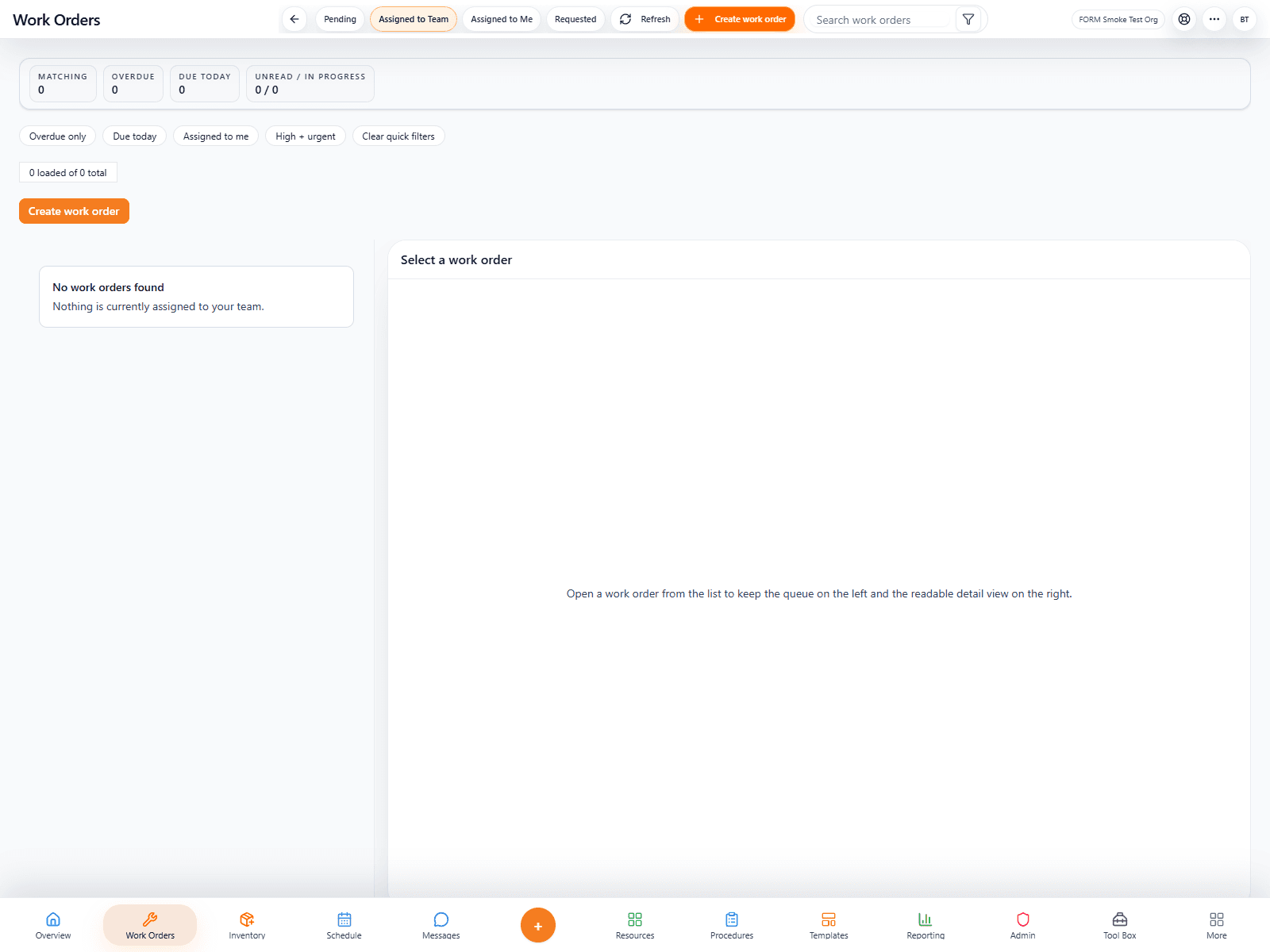
Intake
Capture the problem with enough context to act on it.
Work Orders starts with cleaner intake so the issue, location, asset, and urgency are visible before the task gets lost in a vague request queue.
Structured maintenance execution without the usual CMMS clutter. The execution engine for maintenance teams that need cleaner request intake, assignment, progress visibility, and closeout proof in one place.
This tool is more than a ticket form. It gives teams one system for intake, assignment, proof, history, and follow-through.
Work Orders starts with cleaner intake so the issue, location, asset, and urgency are visible before the task gets lost in a vague request queue.
The tool keeps responsibility, status, supporting notes, and attached proof visible while the job is actually being handled.
Closed work becomes searchable history that strengthens future diagnostics, training, budgeting, and asset care.
FORM Work Orders gives organizations a cleaner execution layer for incoming requests, live status, and durable completion history. That matters because weak work tracking usually means weak accountability too.
If an organization loses work in email, texts, radio chatter, or memory, this tool gives it one place to capture and finish that work properly.
This is a direct fit for organizations with recurring issues, preventive work, and a need for searchable maintenance history.
Leaders get a stronger picture of open work, recurring problems, and team responsiveness without chasing updates manually.
The earlier a team stops relying on informal follow-up, the easier it is to scale cleanly.
AI in Work Orders reduces intake friction, helps draft better tickets, and learns from the patterns a team handles repeatedly.