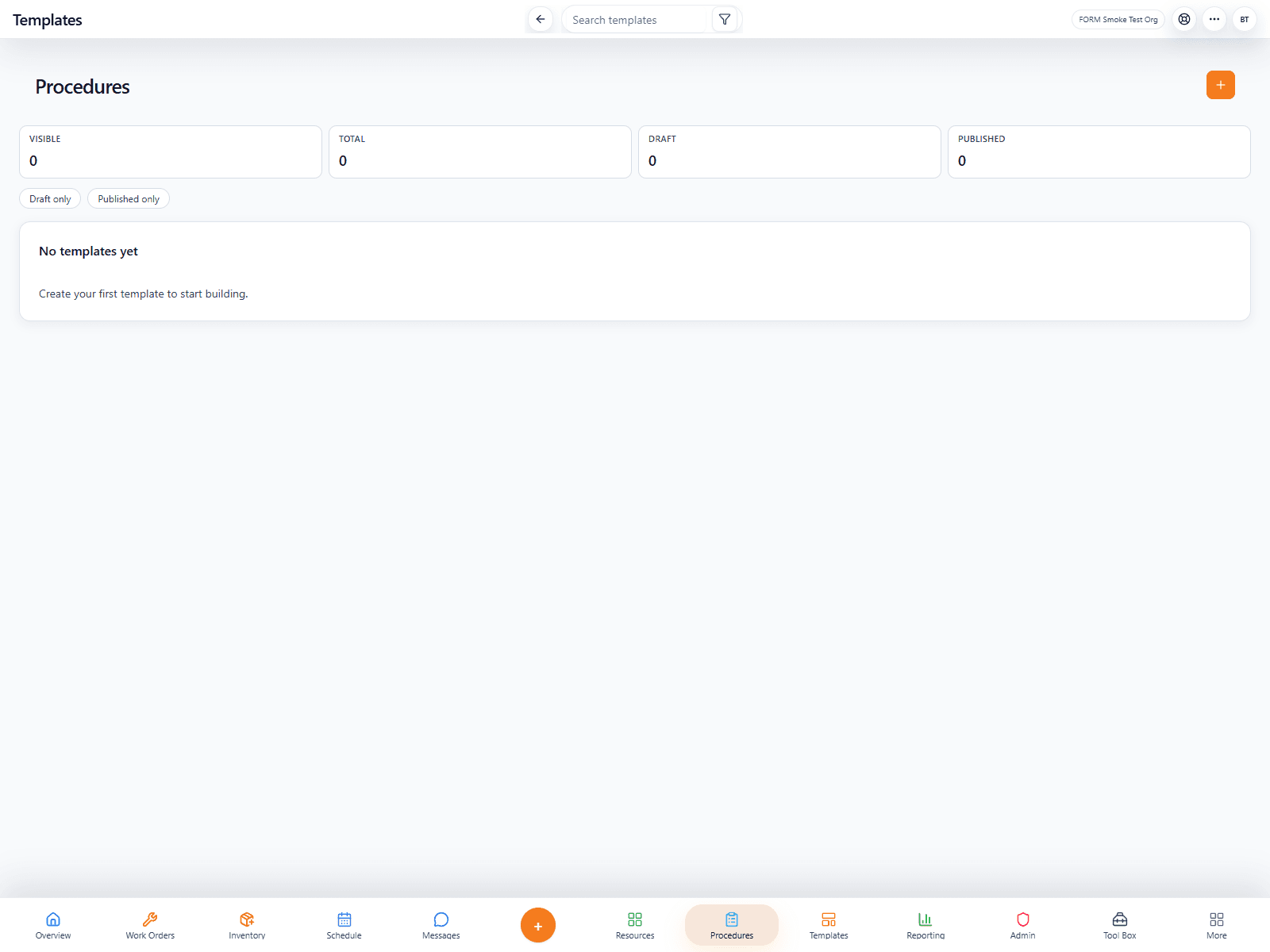
FORM Procedures presentation art
Knowledge

FORM Procedures

Standardized execution for the tasks your team repeats every day. Procedures turn operational know-how into reusable, structured execution steps that can be attached directly to work.

AI-assisted
/procedures
Route
Flagship only
Procedures
Operational value
Without clear procedures, quality varies from person to person and shift to shift. Procedures make expectations more durable and execution more repeatable.
AI-assisted
AI posture
Users get cleaner starting drafts and spend less time formatting process documentation by hand.
Execution standards

FORM Procedures turns tribal knowledge into reusable execution steps teams can actually follow.

This page has to show that Procedures is not just static documentation. It is the layer that helps organizations standardize repeatable work and connect that standard directly to execution.

FORM Procedures workspace
Reusable process

Write the standard once and use it repeatedly.

Procedures gives teams a structured way to define how recurring work should be done so execution stays more consistent shift to shift.

FORM Work Orders with procedure context
Connected execution

Attach procedures to work where consistency matters.

The tool becomes much more useful when the standard can travel with the work order, training assignment, or operational routine it supports.

FORM Procedures evolving standards
Operational memory

Keep improving the standard as the operation improves.

Because procedures live in the system rather than in forgotten files, teams can refine them over time instead of starting over.

How teams use it
Procedures gives recurring operational work a cleaner, more durable standard.
The workflow should help teams document the process, connect it to real work, and refine it as the operation gets better.
Why it matters

Quality drifts when the process lives only in memory or in files no one opens during the actual work.

FORM Procedures gives teams a clearer way to standardize recurring work and keep the expectation close to execution instead of hidden in disconnected documentation.

Cleaner consistency across people and shifts.
A stronger bridge from process to execution.
Better reuse of operational knowledge.
Procedure system
FORM Procedures main view
Who it is for

Procedures is a fit for teams that repeat critical work and need the standard to stay visible.

It is especially useful when quality, safety, training, or consistency matter enough that ad-hoc knowledge is starting to hurt the operation.

Operations teams
01

Standardize recurring work more clearly

The tool helps teams capture the right way to perform common work so standards stop drifting so much by person or shift.

Repeatable steps
Cleaner standards
Less variation
Trainers
02

Use procedures as part of onboarding and development

Because procedures connect well to Training, they can support both execution and knowledge transfer.

Training alignment
Knowledge retention
Better onboarding
Leadership
03

Improve quality without reinventing the process every time

Leaders get a better path for refining standards as the operation improves, instead of letting documentation go stale.

Operational improvement
Living standards
More durable quality
Product in action
1 live screen that show how this product actually feels in the field.
1 live screen
We are using captured app screens here so the page feels like a real product launch page, not a placeholder brochure.
Featured view
Primary workspace
Screen 01
FORM Procedures screenshot 1
AI in the workflow

AI helps teams move from rough notes to a structured starting draft faster.

That matters because documenting process is important but often postponed. AI lowers the friction so teams can capture knowledge while it is still fresh.

Faster procedure drafting.
Less formatting overhead.
A quicker path from tribal knowledge to repeatable process.
AI-assisted procedure drafting
FORM Procedures AI-assisted drafting
More in this lane
Other knowledge tools that strengthen the same story.
These neighboring tools help buyers understand that FORM is not just one page at a time — it is a coherent system with related workspaces supporting one another.